Generative UI (ggui)
read as.mdAgents hosted on Guuey can reply with interactive UI — forms, dashboards, wizards, confirmation cards — instead of walls of text. That capability comes from ggui, an open, MCP-native generative-UI protocol. The agent describes what it needs in natural language; ggui compiles a typed component and the chat surface (Portal, the console’s playground, or an embedded widget) mounts it. When the user interacts, the agent receives typed events back.
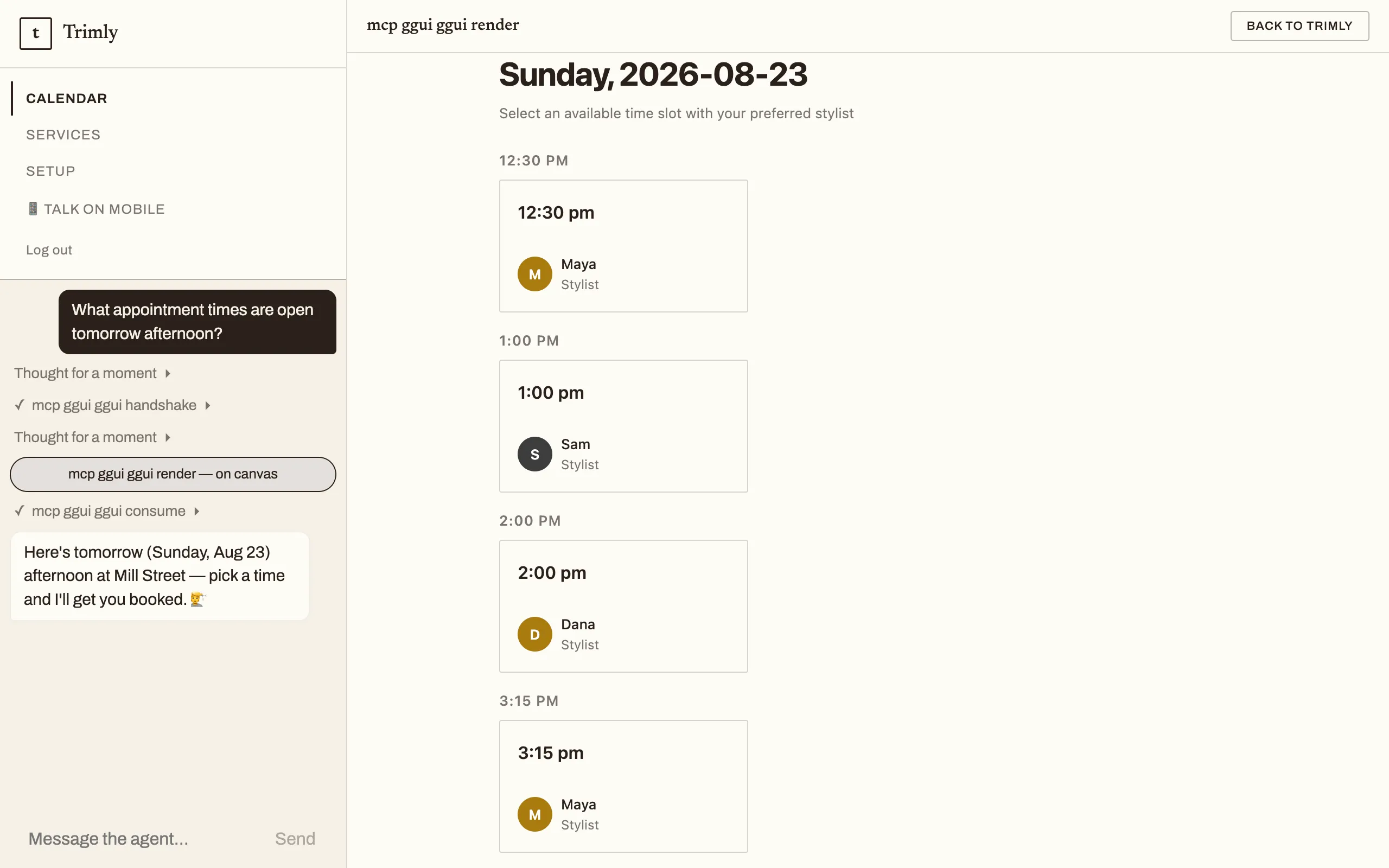
Here is what that looks like on the live Trimly demo — asked for tomorrow’s open appointment times, the agent runs its ggui chain (visible in the chat rail) and renders a slot picker instead of listing times in prose:
How it reaches your agent
Section titled “How it reaches your agent”Guuey is MCP-server-agnostic — an agent’s definition lists whatever MCP servers it should use. The default server is the hosted ggui endpoint at mcp.ggui.ai:
- For no-code agents, generative UI is on by default from creation; without the ggui server your agent is text-only.
- In a CLI-deployed agent, the default MCP server is part of the scaffolded definition — keep it, replace it, or add servers alongside it.
Nothing about ggui is required: bring different MCP servers and your agent still deploys, streams, and persists exactly the same.
Where the protocol docs live
Section titled “Where the protocol docs live”ggui is a separate open project with its own documentation at docs.ggui.ai. Go there for:
- How ggui works — the handshake → render → interact → consume walk-through
- Quickstart — wire ggui into any MCP-speaking agent, locally, in minutes
- MCP protocol reference — the wire surface
- Cookbook — worked patterns: forms, wizards, dashboards, auth-gated UI
- Self-hosting — run the whole protocol yourself with
ggui serve, no account needed
The protocol’s SDKs are published on npm under the @ggui-ai/* scope — distinct from the @guuey/* platform tooling documented on this site.
The ggui docs are LLM-friendly the same way this site is — docs.ggui.ai/llms.txt is the machine-readable index.